Year in Review - 2025

As 2025 recedes in the rear-view mirror, it’s time to revisit what ended up being a very busy year.

After taking a chunk of time off for creativity in 2024, the past year was dominated by programming contracts, leaving me with less time to split between my various creative projects. Somehow I still managed to get quite a lot done!

Visual Art

One of my major goals going into 2026 was to finish my Elden Ring Photography Tour. By the end of 2025, I’d taken and edited over a thousand in-game photos, but still needed to curate and write alt text for almost 600 shots.

By the end of November, this mammoth project was finished, including a novel’s worth of alt text across eighteen albums, charting my journey through the Lands Between and into the Land of Shadow.

Once, three decades ago, I tried to draw a squirrel. I had a reference image of a squirrel, I could hold that image in my head and focus on all the details I liked, and when I put my pencil to the page, that image utterly failed to translate into anything resembling a squirrel.

In the years since, that became part of my internalised narrative. That I might have an eye for composition, I may be able to take photos and edit for contrast and tone, but I can’t draw art.

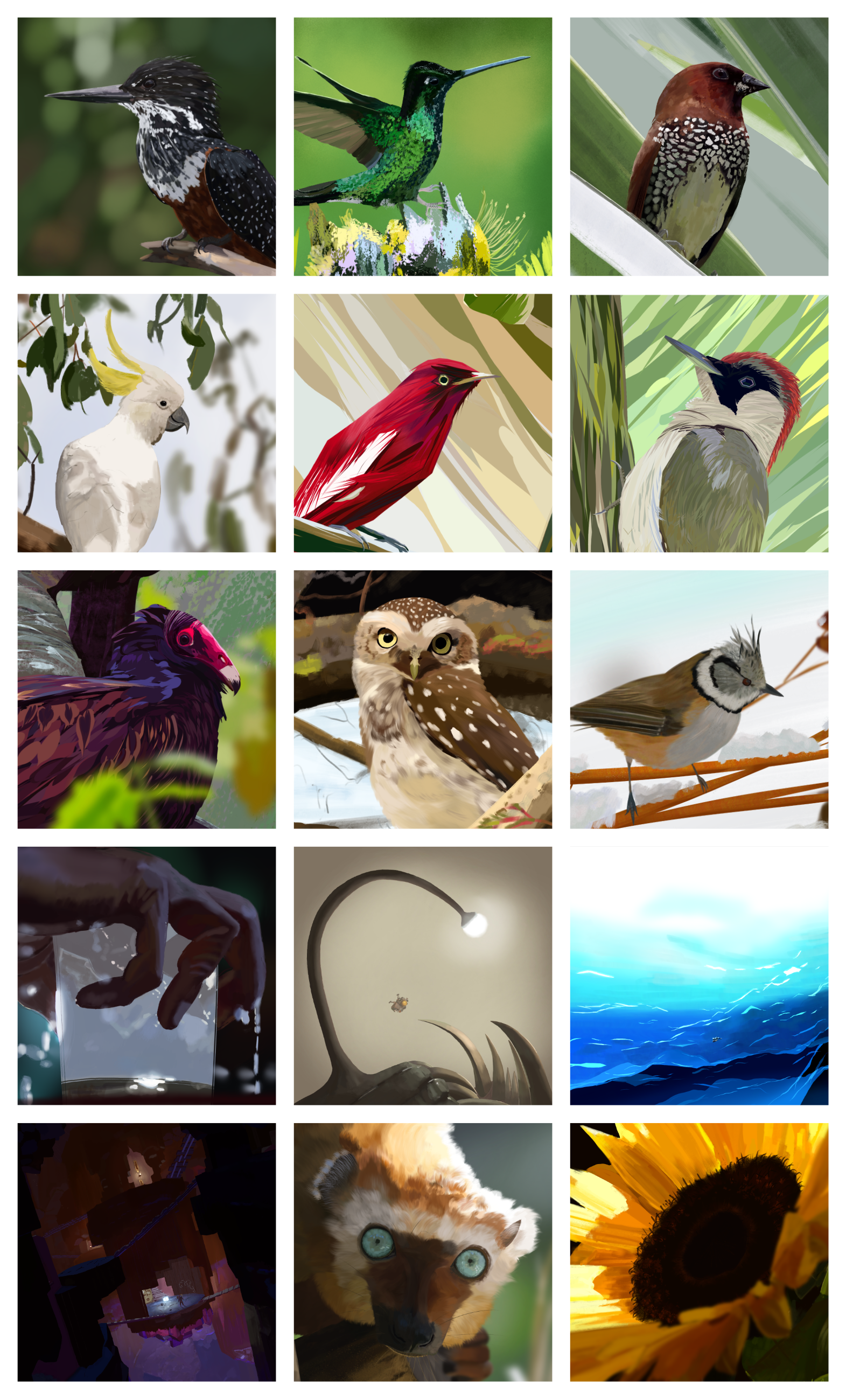
So early in 2025 - armed with good references, my photo editing tablet and a copy of Clip Studio Paint - I decided to disprove this long-held tenet. By the end of the year, I finished 19 paintings, to various degrees of fidelity. Some ended up as unsuccessful experiments, but as a body of work, they’ve firmly disproved that self-imposed myth.

A 3x5 grid of squares containing excerpts from paintings I made in 2025. From top-left to bottom-right: 1) A kingfisher perched on a branch; 2) A green hummingbird; 3) A brown and white munia; 4) A white cockatoo; 5) A stylised pompadour cotinga in shades of bright red; 6) A green and white woodpecker with a red and black head; 7) A vivid purple-brown turkey vulture; 8) A small brown owl with fluffy feathers; 9) A crested tit on a snowy branch; 10) A hand grasps a mixer glass full of pale liquid; 11) A giant anglerfish in pale mist; 12) Waves of blue light; 13) An underground city of hexagonal columns; 14) A blue-eyed black lemur with golden fur; 15) A close-up of a sunflower

It was also a year for photography of the living world. I spent June crouched in my garden, taking close-up photos of bees; I took a sunset trip to our local conservation zoo; I charted the course of the seasons through our garden and nearby woodlands and the creatures living within.

Writing

It was a slow year for writing. I’ve often been forced to recognise that the part of my brain that puts together professional code for my clients is the same part that constructs arguments in non-fiction essays, that binds together webs of character arcs in fiction, so when paying work takes precedence, my writing often suffers in priority.

Even so, this year included a milestone in my writing career that I’d been working towards for a number of years: my first professionally-published short story, in Factor Four Magazine: These Hearts, Who Once Held Up the Sky.

I love this story; its themes of burnout and community are very dear to me, and I’m proud of the response I’ve had from readers. It doesn’t resonate with every reader, of course, but for those who recognise those entangled themes, it hits home, and that’s all I could ask for!

I also took part in FletchFest 2025 and the Exilian Winter Competition, and wrote two linked microfictions: What Warmth We Have, & Within Icebound Hearts

Music

2025 marked some big strides in my piano playing. This is something that’s hard to quantify, but I’m proud that I put the practice in, and made notable improvement.

It was also the year that I figured out how to practice in a way that stuck, how to slow down and engage with the material in a way where I could feel the gears of my brain bite against the written notes, instead of brute-forcing whole pieces through a matter of rote repetition.

Piano will always be a hobby I guard somewhat protectively. It’s my haven from all the creative practices I have where being good at them is a driving force; I’m okay if making music ends up being just for me.

That said, over the past year I’ve played around with recording short pieces of improvisation, and experimented with more piano arranging. A lot of these explorations ended up in creative dead ends, but simultaneously I learned a lot from them.

2026 is shaping up to be another busy one. We’re in the calm before the storm right now, the grace offered by the end of the holidays, but I’m excited to see what creativity the year holds!

The Fear of Missing Updates

There’s a widely-accepted wisdom in this age of social media, that to build an audience of any kind you have to be consistent.

One comic strip every morning, re-treading the footsteps of newspaper syndication. A polished sketch each day, sacrificed upon the altar of the Algorithm to grease the wheels of virality. Videos, articles, recipes, a steady churn of SEO-friendly content to be sure your audience always has something new to experience. To make them want for more is sin, to make them wait is heresy.

And sure, that’s one approach: to be an awe-inspiring fountain of creativity, to pour yourself out upon the world and hope that your aquifer truly runs as deep as you believe. But it’s not always sustainable when set against real-life challenges and stresses, when the creative drive runs dry, when that break-neck pace breaks you.

And then all you’re left with is an unmoored feeling of guilt.

You see it in apologetic “I know I haven’t posted in a while, but…” social media posts all the time, as if taking a break from the churn requires penitence. And while I empathise with the emotional cocktail behind those posts, the one thing your audience wants to see less than no content is a self-effacing apology for not keeping up with a self-imposed treadmill.

“Ah, but Rob,” you say, “isn’t this you taking the scenic route to talking about your own guilt for only updating this site a couple of times this year? Seems like a somewhat-hypocritical rhetorical device to me.”

And I’d chuckle and say “Except I’m not apologising. I’m saying maybe there’s nothing to be guilty about.”

I’ve talked before about the challenges of curating content, of ensuring the signal rises above the noise, but often the challenge is - having found your audience - managing an excess of signal. There is so much to read, so many games to play and art to see, and very few folks have time to visit their favourite hundred websites each morning in case there’s something new to see. So how do you keep your audience informed when you do have something to share with them?

For many years prior to social media, and still today, one of the best answers is RSS. Get your audience to subscribe to the RSS feed for your site, and it doesn’t matter how often or infrequently you update, they’ll be informed when you have something new to share.

I’m a big advocate for hosting your creativity on your own site, and RSS is one of those key pathways to keep your audience in the loop without feeling beholden to algorithmic regularity or burnout-inducing schedules.

But crucially, visitors to your site have to know about your RSS feeds. This site is created with Hugo - which has RSS functionality built in - and I’ve had RSS pages available since launch, but aside from the occasional blogpost link, I never got round to making it clear what pages had RSS feeds.

That’s now fixed, and you should find the orange RSS logo at the top-right of each page with a feed.

So what have I been up to in 2025, you rhetorically ask?

  • My first professional-rate short fiction was published at FactorFour magazine: These Hearts, Who Once Held Up the Sky

  • I’ve been busy working away at wrapping up my Elden Ring photography project, from Caelid through to the opening act of the DLC: Elden Ring Photography Tour

  • After thirty-plus years believing that I couldn’t draw, I decided to take up painting, with a focus on studies of birds and my own Outer Wilds photography: Art Studies

  • Taking photos of small things has been a big focus of the summer so far, and I spent most of June crouched in a clover patch taking photos of bees: A Bee-stiary

  • I’m also working up to posting more of my music here; I’ve experimented with it in the past, but I’m currently planning to record some of my piano improvisation for a new Music section. This isn’t quite ready yet, but I’ve condensed the navigation bar to leave room for this new section, so with a following wind it won’t take long!

Maybe I’ll be posting more in the next six months.

Maybe I’ll wrap up some of the essays sitting in my “just one more editing pass” folder, and feel that sense of relief that they’re no longer running round inside my head.

Maybe I’ll post some music, or more artwork.

And maybe not, if work and the world keep me on my toes and the months slip away. I’ll still be making things; sometimes they’re just not quite ready to share.

I’m not going to feel guilt for taking the scenic route through my creative life, and neither should you.

Creative Wrap Up - 2024

It seems like a new commercial season has sprung up in recent years, a short period where all the big brands attempt to summarise the first eleven months of the year as if December is an eldritch dead-zone of which We Do Not Speak. Nothing says “we value our customers” like using massive datasets to commit ill-considered acts of statistical cold-reading on a massive scale in an attempt to get people talking about your product.

I’m not averse to Wrap-up season; it’s harmless enough as corporate advertising goes, and while I have many qualms about the flagrant misuse of statistics, I appreciate a lens with which to view the time that’s passed. We can all use a pleasant retrospection now and then.

Back in early December, my multi-talented friend Fletch ran with the concept and created a summary of his creativity for the year. Especially for those of us who meddle in multiple fields, it can be very easy to forget what we’ve accomplished, and I find this sort of summary really valuable as a reaffirmation of the shape of our creative year.

So with the end of 2024 rushing upon us, I thought I’d do a similar exercise, breaking down my various creativities over the year into easily-digestible metrics and presenting them in an approachable format:

A simple graphic summarising my creative progress in 2024. Panel 1: 21 Stories & Essays, broken down into 10 Microfictions, 2 Short Stories and 11 Essays & Blog Posts. Panel 2: 13 Photography Sets, broken down into 150+ Photos of Animals & Nature, and 400+ In-game Photos. Panel 3: 3 VGM Piano Arrangements, specifically Skies of Arcadia: Main Theme, Outer Wilds: Travelers, and Outer Wilds: Elegy for the Rings. Panel 4: And 1 Custom Website to Share Them All, including 150+ pieces of writing, 800+ photos, and blogposts about persisting as a creative in the 21st Century. Below is my website URL, robhainescreative.space

Thank to everyone who’s visited this site or enjoyed my work on social media this year. I’m excited to dive back in to making things in 2025, and I’ll see you all then!

A Creative Retrospective

As of the end of October, I’ve got a job again!

Being a contractor and creative, that simple statement always comes with caveats. I’ve been employed all year, but without an active client I’ve essentially been a full-time creative. Now I’m actively engaged with programming work again, I’m falling back to being a part-time creative.

And while I’m genuinely excited to get working on my new contract, it also gives me a chance for a moment’s introspection, looking back on the past ten months and seeing what I did with that time.

One final caveat, before I dive in: I’m fully aware that being able to take a number of months off to solely work on unpaid creativity is a huge privilege. In this case, it’s somewhat built into the transient nature of contract work. I hadn’t intended to be without contract for this long, but when I realised that the market was as barren as it has been this year, I was determined to make the most of it.

With hindsight, I think I did.

At the end of last year, I made myself a three-page list of things I wanted to do once I finished my existing contract. I ended up doing maybe half of them.

Top of the list was to build myself a website. If you’re reading this, I guess I succeeded!

Second was to rework my piano setup so I could start playing around with composition and arranging, which was a major focus of the past few months.

I didn’t anticipate the third major creativity of the past year; I probably spent more time working on my Elden Ring photography than anything else during this period, and loved the whole process.

“Three things,” says my brain. “Is that all you did?”

Calm your neurons, let’s do some reframing.

Something I’ve figured out over the past few years is that I’m not great at having perspective on my creative work when I’m not in the midst of it.

In the desire to avoid “laziness” (which in itself is a whole loaded term full of unreasonable expectations and Puritan work ethic which I don’t have time to unpack right here), my brain is wont to ignore piecemeal creative endeavours, to dismiss subconscious effort and the need for rest and the endurance of rolling with life’s punches.

And given the caveat at the top of this piece, I felt it doubly-so: devoting this time to creativity was A Privilege. I’d better Make Good Use Of It.

Taking each creative task in isolation, I’m always going to feel like I didn’t do enough.

Which is why timelines soothe my brain:

A horizontal timeline chart showing creative periods from Jan-Jun 2024, across a number of categories. Coloured bars show that I've been pretty busy, focusing first on Programming/Web Design, then on In-game Photography during this period.
A horizontal timeline chart showing creative periods from Jul-Oct 2024, across a number of categories. Coloured bars show that I focused on In-game Photography for the first part of this period, then transitioned to Music for a number of months.

Laying out all my work this year in its various categories and seeing how each piece fits into the chronology of my year so far puts everything in perspective in a way that my brain cannot deny.

With this perspective, it’s undeniable: I spent the first chunk of my year focused primarily on my website, the second chunk focused on Elden Ring photography, and the last few months on piano arranging.

And even amongst those blocks, I kept up with writing, bursts of photography, and various other things. This is what I want my creative life to look like, but sometimes when I’m in the midst of it, I struggle to see the contours.

Simply the Best

After an internet outage that put a damper on my creativity for much of last week, this weekend I decided to try something I’d been thinking about for a while: identifying my best work.

And because this is me - and I am wont to overthink such things - I immediately ran into issues of definition. How do I define best? Am I a good judge of my own work? Can I reconcile the idea of best with the variety of creativity on this site?

Perhaps more pressingly: can I bear to whittle away at my body of work to decide which pieces I like the most?

A lot of this comes back to my thoughts on curation over the past few months. I don’t put anything up on this site which I’m not proud of, but there are some microfictions that work better than others. There are photos that achieve everything I wanted from them, and others that just about get the point across.

Perfection is worth aspiring to, but actively harmful as a metric of success.

And of course, as I’ve seen with reactions to my microfictions on Mastodon, sometimes stories that I thought were good but not exemplary really land with readers. Art, after all, is a communication between artist and audience, and you all bring your own preferences, your own tastes and appreciations to a piece. So I have to recognise that my best pieces are highly subjective.

Which pieces of work am I the most proud of? Which stories speak the most deeply to me, which resonate with my soul and which I have a reasonable belief will resonate with the majority of my audience?

Trimming the possibilities down to five written pieces or ten photographs per category was sometimes painful, but I found the process fascinating, especially trying to winnow down the last couple of options. Sometimes I just had to accept that two pieces satisfy my creativity in very similar ways, and fall back on which of these could I not do without.

So, I’ve curated four collections of what I consider to be my best work so far, in the fields of microfiction, videogame essays, photography and in-game photography (in this case, strictly limited to photos of Elden Ring, since that’s been my main focus this year).

I plan on revisiting these collections over time, updating them with my current favourites, and hopefully there will be a decent amount of change as I grow and expand my efforts.

I hope these serve as an effective intro to my work for those new to the site, and an insight into how I judge my creativity, for the rest of you!

The Challenges of Curation

Sometimes it seems like curation is ninety percent of running a website.

This topic has been forefront in my mind recently while working on my Elden Ring Photography Tour. I’m almost done with playing the game at this point, and the process of editing photos has become second nature. I can put on a stream or listen to some music, and carve through fifty or sixty photos in a sitting, discarding another hundred along the way.

And then my brain says “Cool, job done! Time to put a new album up on the website.” and I have to intervene. Because the chasm between merely having the photos and having an album with flow and an internal narrative - not to mention a wider macro narrative of the progression across my whole Elden Ring project - is vast and meaningful.

Elden Ring, in particular, draws attention to this difference. The sheer number of branching paths, the openness of its world, the near-infinite possibilities of routes I could have taken through the game, all make the idea of a single narrative difficult to set in stone.

But I’m a storyteller. I don’t want to provide a chaotic window into a world; I want to share with you my journey. I want you to feel the flow of my progression, and given FromSoft’s incredible work with building tension through art design, it would be foolish not to want to leverage some of that as part of this chronicle.

Without curation, the photos I love don’t get to shine, because they’re buried in a morass of other art.

Without curation - without winnowing out images that don’t work, without setting the images into a meaningful order, without alt text and intent and everything being in its right place - I don’t get to tell a story.

I launched this site four months ago. In that time, I’ve featured eighty-two stories, essays, photo albums and blog posts on the front page, each hand-selected to share something about who I am as a creative.

And each week, when I sit down to curate my body of work and decide what to share, I find new things to love about what I’ve made over the past decade. Curation is living with your work, but perhaps more importantly, curation is part of setting your work into a wider narrative of your creative life.

Beyond your own work, curation is engaging with the work of others, of finding creative expression that resonates with you. Curation is an act of communication, just as much as art is.

In my first blog post on this site, I touched on the topic of curation as one of the failings of the modern internet, that we collectively outsourced curation to media companies with promises of endless algorithmic content. We believed the lies that a chance of going viral was better than slow, persistent growth.

We believed that curation was something to be performed by unthinking software, not as personal expression.

I had a conversation with a friend this week about a company who are trying to solve the problem of discoverability in the indie game space by using LLMs and AI voice algorithms to generate Youtube videos summarising high-rated Steam games with few players, in an attempt to drive awareness of their existence.

I have a number of issues with this approach - not least the use of unethically-sourced and environmentally destructive AI models - but after some discussion I found the core of my distaste for this otherwise well-meaning project. They’re trying to solve the problem of curation - lack of meaningful signal - with machine generated noise.

It’s a doubling-down of the idea that curation isn’t meaningful, that curation isn’t an artistic or creative act. The idea that curation isn’t cool.

Let the machines do it.

But as a rule, we don’t like taking recommendations from machines.

Algorithms don’t understand us. They offer us a thousand books about unicorns because we loved one specific book about a particularly beautiful friendship with a unicorn. They beg us to buy a thing functionally identical to a thing we just bought. They recommend us games because our friends are playing them, or because we liked something in the same wide-scope marketing genre, not because this game in particular will resonate.

Our friends understand us. They tell us about a book that they like, that they think we might like, and their eyes light up as they tell us about the connection they made with the characters and the narrative arc.

“You have to play this game,” they say. “I can’t tell you anything about it, but you’re going to love it.”

Curation can even come from those who do not know us, but who have cultivated that consistent sense of What They Like. In their blog posts, in their social media mentions, they talk effusively about What They Like, and you know - just by reading - that you’re on board with whatever follows.

I have some other thoughts on curation and the modern internet, but they’re still burbling away while I figure out my own solutions.

At the heart of it is the idea that we need to take curation back. We need to talk more about the things we love, to cultivate that bubble of These Are The Things I Like, And I Think You Might Too. We need to share sites and posts and books and songs that resonate with us, so that our friends and acquaintances see us glow bright with the fire that art has lit in us.

We need to make curation cool, once again.

Do the Work
Word Choice and "Cancel Culture"

I happened to stumble over yet another interview this week with a big name writer - who shall remain nameless - complaining about their fears of being cancelled. And it irked me. 

At this point it’s a pattern, so let’s call out a few common idiocies I see in these interviews:

  • Drawing false equivalences between Christian fundamentalist book bannings and “but I can’t write a slur any more (without risk of criticism)”.

If you genuinely believe your right to use harmful slurs without censure is of equivalent weight to the right of queer folks to exist, any conversation you and I have is going to be short.

And if you didn’t intend that equivalence, maybe you - a writer - need to choose your words better.

  • “But what if someone reads one of my books fifty years after I’m dead and calls me a bigot? I must rail against cultural shifts over time!” 

My Dude, your hubris is showing. No-one’s going to want to read your books fifty years after you’re dead.

Less facetiously, yeah, this is gonna happen. Cultural mores change, what is acceptable now may well not be in the future, and you may not be able to prevent that.

What you can control is whether your work harms people now, and mitigate that in the present, and may I suggest this is more important than getting angry at some theoretical strawman scenario occurring long after you’re dead.

  • “These days I have to stop and consider the words I use, because what if I describe someone different to me with unacceptable words?” 

This one comes up every fucking time, and it blows my mind. “Using words that mean precisely what you want them to convey, to the best of your ability” is literally the job description.

(With a big ol’ side order of “and if you have sufficient privilege to have run roughshod over the job description this long, maybe do some introspection before showing your ass on the topic in a major newspaper interview”.)

Yes, you - a writer - are responsible for the words you choose.

Yes, you - a writer - should understand the nuances and connotations of the language you employ, doubly so when that language has - historically and contemporaneously - been used as a shorthand for dehumanisation and diminishment.

Yes, you - a writer - may need to do some homework if you are not thinking about words in this way.

No, you do not get a pass if you are exceptionally prolific, or mildly famous. If anything, we will expect better from you because you can afford to do that work.

Take that time. Hire sensitivity readers in good faith, and internalise what they’re telling you.

Do the work.

As a writer, as someone who cares deeply about words and their effect on other human beings, I find these interviews baffling.

Do these famous writers really not care about the meanings of the words they use? Are they so afraid of being criticised for harmful language, but care so little about actually causing harm?

Or do they simply not want to do the work required to be a decent human being, and are terrified that someone will make them.

For anyone reading this who agrees with the famous author:

It’s okay. No-one expects perfection.

We are expecting the same degree of work to go into word choice as into your worldbuilding and character development.

We are expecting you to choose words that you can stand by, that you mindfully employed, aware of the impact that they may have on other people who are not like you.

That’s the job.

And if you - a writer - are not willing to imagine yourself in the shoes of someone who isn’t like you, maybe you should give it a try.

I promise it’ll make you a better writer.

In the Spirit of Communication

Live with a cat long enough, pay enough attention to their body language, their routine and mannerisms, and you’ll begin to understand them.

Talk to them long enough, they’ll learn the inflections of your voice, identify specific meaningful words, responding to promises of dinner with excitement, or hushed mutterings about the vet with burrowing as far from visibility as they can manage.

We all communicate with our pets, to varying degrees, but body language and routine are imprecise forms. I’m by no means the first pet owner to wonder if something’s getting lost in translation.

But communication is kinda my thing, so when I heard about people teaching their pets to use communication buttons, I had to give it a go. My wife and I have spent the past two years training our cat Poppy to talk to us, and it’s been a wild and enthralling experience.

A quick caveat: I’m attempting to approach this process with a scientific eye and an awareness of the risks of anthropomorphisation. That said, I’m aware I have an emotional attachment to Poppy, and due to the relative imprecision of the modelling process there is a degree of reading-between-the-lines required in interpretation of her button-usage.

I’ve talked about Poppy and her buttons on mastodon a fair amount, but since I’ve had a number of people tell me how interesting they find the process, I thought it was worth a more in-depth discussion.

Poppy’s up to fourteen FluentPet buttons at this point, in five general categories:

  1. Names
    • Poppy
    • Dad
    • Mom
    • Friend
  2. Activities
    • Play
    • TV
    • Bedtime
    • Uppies
    • Shell Game
  3. Needs
    • Love
    • Hungry
  4. Observations
    • Outside
    • Noise
  5. All Done
    • All Done

Of these, Poppy uses five (“Uppies”, “Shell Game”, “Love”, “Hungry”, “All Done”) on a daily basis. The rest she uses with differing regularity, and we use them to model meanings to her by saying the words and pushing the buttons while demonstrating the meaning.

It’s been fascinating to see semantic drift in action, even on this small scale. Part of the learning process involves being as specific as you can while modelling meanings - because any misunderstanding during initial modelling is going to be exacerbated with repeated use - but even with words where the initial use seemed to be understood, over time the meanings have subtly shifted.

“Friend” was originally modelled based on our neighbours visiting the house regularly for a number of weeks, to get Poppy used to other people being in the house. (We have the best neighbours.) But we have clearly told Poppy she’s our little friend in the past, because she’s started using it in interactions directly with us, presumably as a term of endearment.

“Uppies” began as “to be picked up”, but - presumably due to Poppy’s routine of being carried upstairs for us to marvel at her eating her breakfast - she occasionally uses it to refer to “upstairs”.

“All Done” was originally modelled as “whatever we were doing, is finished now” (Play All Done, Noise All Done, etc.) but it’s become Poppy’s most-used button on the mat with an array of apparent meanings, from “this conversation’s over” to “you’re still sitting there and I don’t appreciate it” to a general sense of frustration.

Even more interesting is that while she generally uses one button to express a thought, she will occasionally construct a multi-word thought, which requires more interpretation on our part.

Recently we’ve even been able to tell when she’s constructing a phrase because she’ll sit beside the mat, lifting one paw in place as if imagining pressing the desired words, sometimes for several minutes before she approaches the buttons and rapidly types out her phrase.

Examples of this include phrases such as “Outside Bedtime” after coming back from the window after dark, “Outside Friends” when we were cleaning the house late in the evening and that’s a rare-enough occurrence that she’s anticipating guests, and various combinations of “Bedtime” “Love” and “Hungry” to mean “I’m sleepy and the only thing that’s keeping me awake is I haven’t had my food yet”.

This is something we’re hoping to see more of as we increase her vocabulary, but it’s been a promising start.

So how did we get to this point?

I started out teaching her to touch the top of an object with her paw; I’d double-tap the object in question with my index-finger and ask her to push it, and she’d get a treat for putting her paw on it.

When we received the FluentPet buttons, I kept one of the buttons disabled and used that as a training button. We developed our previous game of touching the object, except she only got the treat if she touched it hard enough to make the button click. (This also aligned nicely with the clicker training I’d used the previous year to get her accustomed to having her claws trimmed.)

After a few weeks of that, we then introduced the mat, with “Play” and “TV” buttons for her favourite activities. And despite modelling the buttons consistently, Poppy ignored them.

We’d previously read that best practice is to not associate pressing the buttons with food - aside from the initial training with the dummy button, at least - so we resisted giving her a “Hungry” button for some time, and continued with her training. But Poppy is a very food-motivated cat, so eventually we relented.

And suddenly, she understood that “Hungry” was to ask for her mealtimes, and the other buttons were to ask for her other activities.

Since then we’ve been gradually rolling out buttons a few at a time, adding them in pairs or groups of related/opposing meaning where possible. A lot of the time it’s a matter of recognising words that we’ve already been using consistently with her - such as “Love” and “Outside” - or things that we think she might want to ask for.

Most recently “Shell Game” was a real hit, after I taught her how to play three-card monte with a set of cups and hidden treats. She asks me to play every morning, and gets so visibly excited when I set everything up.

When she responds so strongly to us providing something she’s actively asked for, I can’t help but think there’s more to it than just her excitement over playing her favourite game. She asked for something, using a language which doesn’t come naturally to her, and she was understood.

And it seems there’s a thrill in being understood that crosses species.

A Window to Imaginary Worlds

I never used to take screenshots of imaginary worlds.

I love being immersed in games, of marvelling at the wonders their designers have imagined, that their artists have dragged into existence through sheer talent and application of their hard-earned skills. I love walking through places that could never exist, sitting on benches beneath skies filled with dragons and infernal fire, taking a moment to soak in the impossible.

But documenting those wonders always felt… I don’t know, forbidden? Unnecessary? Like it was taking their work and claiming credit for it?

It’s only been in the past few years that I’ve started to interrogate those feelings. Some of it is undoubtedly rooted in the collision of childhood wonder with “Why are you always playing games? They’re not real. They don’t matter.”

But they do matter. They make me feel awe and belonging and competence and delight. And if these worlds - crafted by human hands and hearts and minds - are full of wonder, should that wonder not be shared?

So back in 2022, I set out on my first in-game photography tour, with the intent to treat the photos I produced with the same degree of care as I do with my photos of the real world. After all, if my subconscious thesis statement is that these digital worlds are as worthy of appreciation as the analogue world, I have a duty to treat them with the same respect.

And where better to start than Outer Wilds.

In case you haven’t come across it before, Outer Wilds is a wonderful space exploration game, and one which is uniquely vulnerable to spoilers. Knowing the secrets of Outer Wilds makes playing it somewhat redundant, which is also a challenge for those of us who have played it and wish to spend more time with it.

Photography seemed like an excellent excuse to soak in a beloved world for a while longer.

Of course, in-game photography isn’t always a straightforward endeavour; videogames are often complex illusions, tricks of perspective and special effects that struggle to stand up to scrutiny. In-game tools for switching perspectives or removing player characters from compositions are often minimal or completely absent. Composing and extracting photos from these worlds is a key part of the process, and often a significant part of the fun.

Outer Wilds required a succession of mods to break the camera from the player’s perspective, to freeze time and hide UI elements to frame the perfect shot, and ultimately to output screenshots in higher resolutions than originally intended.

But the photography was all mine. The choice of moment, of framing, of post-processing to achieve a specific effect, all that echoes my process for real world photos. I’m not claiming credit for the developers’ art; I’m holding up a lens to it and saying “Look, see what I’m seeing! Isn’t This Beautiful?

In April, I started playing Nier: Reincarnation, a game on the verge of destruction. Less than a month before its servers were due to be shut down, I decided to document its glorious art styles.

(And glorious they are, despite the relative low resolution of mobile screens, and a lack of anti-aliasing which seems notable given modern game design principles.)

Nier raised some questions for me. My usual mindset has been to avoid taking photos of games with fixed camera angles or starkly-scripted sequences; my internal argument that I’m offering my own perspective is harder to justify when taking a photo of a scene exactly as the developer intended me to see it.

But Nier has fixed paths and an uncooperative camera. In this case - especially since the game wasn’t going to be around for future players to explore - I decided that choice of moment would have to be enough.

And Nier, I hope you’ll all agree, was beautiful.

When I first visited the Lands Between, I marvelled at the sheer wonder that FromSoftware’s artists had crafted, and knew that I’d have to go back, camera in hand.

So I did, and quickly discovered that this was going to be more of a project than I’d originally envisioned. Elden Ring is vast, and between the day/night cycle and emergent elements and seemingly infinite beautiful sightlines, I spent hours just poking and parkouring around the opening regions of the game.

Elden Ring also brings its own challenges to my process. The UI is vital to playing the game but takes up a significant amount of screen space, so I’ve been learning to play without it. The in-game telescope is great as a functional zoom lens, but wide-angle shots require me to crouch beside a nearby rock and clip the camera past my character’s head. And that’s all on top of trying to take photos while everything is trying to kill me.

Needless to say, I’m having a wonderful time!

But it’ll take some time before I’m done, so I’ll be releasing new photo albums as I progress through the game, through grimy mires and crystal caverns, awe-inspiring views of ancient academies and treacherous precipices. To start us off, here’s the first instalment, as I take a wander through the shattered ruins of Limgrave.

Thanks for joining me on these tours, and I hope you enjoy seeing these worlds through my eyes!

One Week Later - Thoughts on a Launch

Launching a new site is always a bit of a leap of faith.

No-one owes you their attention, and on an internet glutted with things to do and read and watch and learn, it’s a very reasonable fear that you’ll put all the work in, craft your space with care and attention, and that - for very reasonable reasons - no-one will show up.

I spent four months working on this site - from initial learning about static site generation, through experimentation, creating a theme and, with my wife’s help, populating almost fifteen years of assorted creativity - and during that process I occasionally worried that this might be meaningful to no-one but me.

I think it’s worth taking a moment to examine this impulse: this site is a container for my creative projects, but it’s also a creative project in its own right. It serves a double-purpose as an expression of my design sense but also as infrastructure, and when I consider it as such it re-frames some of my instinctual fears.

If you build a road, its completion may be the end of construction, but the beginning of its functional life. If no-one uses the road in the first day, the first week, maybe they just haven’t worked it into their routines yet, or figured out how it can improve their life.

Ultimately, even if this project ended up being just for me it would have been a success, a online space for me to ground myself in over the next fifteen years and beyond. I feel pride towards what I’ve built, and a sense of foundation that I never did with transient sites on shifting corporate sands.

But my fears were unfounded: I built it, and you all came. That means an awful lot to me, and I’m immensely grateful for all the support I’ve been shown over the past week.

Thank you for all the kind words, all the signal boosts and opportunities to share what I’ve made with you all, and I hope you find more creativity here that resonates with you!

I’ve always had a curious relationship with numbers. I’m not a big mathematician, but give me three large numbers and I’ll give you an order of preference, based on the relationships between the digits and the groupings, and sometimes based on how they feel.

And I’ve always been data-driven, subconsciously attempting to chart an optimal path through problems through statistics and risk analysis. I’d always rather have a quantified measure of something than just a gut feeling.

So it felt somewhat terrifying to launch this site without metrics.

No visit counters, no tracking cookies, no idea of where visitors are coming from or going to. If I want to know what types of posts people want more of, I have to ask them. And in the third age of the internet, this sort of lack of easily-available knowledge is anathema.

I’ll admit to being a little disconcerted mid-week when I wondered how the site was doing, and had to gently remind myself that Not Knowing was by design. I sat in that discomfort for a little while before I came to a realisation: the metrics were never meaningful.

Sure, if you’re a major site beholden to advertisers you need those numbers to support why other companies are giving you money. If you’re owned by corporations and need to prove to their shareholders that you’re worth their investment, metrics are invaluable.

But for me?

I’ve always had visitor metrics on my creative websites, and they never really resolved into anything actionable. Did people come to my site because of specific social media posts, or because it was a slow Tuesday? How many of those visitors were bots or scrapers, drawn by posts unwittingly meeting some algorithmic criteria?

Having those metrics available meant I had to care about them. I had to watch the curve of visitor numbers and try to rationalise them, because maybe, just maybe, I could make them go up again.

Worse, every personal creative site has its quiet periods - usually when you’re actively working on something, and all you need to do is focus on getting it done - and metrics in those downtimes can be actively demoralising.

I’d much rather have space to believe that people are visiting than have quantifiable proof that they aren’t.

For the first few months, at least, I’ll be highlighting a different set of works each week on the front page. There’s a lot of writing and art in the archives that I’m proud of, and I’m delighted to share these pieces with you.

If any of these resonate with you, please share them with others who might enjoy them. I’m fully reliant on word-of-mouth and recommendations from kind folks to spread the word of what I’m doing here, and I’d very much appreciate any help.

This week’s highlights:

  • The Distance That Remains [Microfiction] Two titans, destined to meet, stand face to face at last.

  • Assorted Textures [Photography] I love a good texture, crisp and clean, like you could just reach out and touch the surface and know exactly what they feel like. Here’s a selection of my favourites.

  • Friday Night in the Hostile Environment: Not Tonight and Satire [On Videogames] Not Tonight tries to paint a cautionary tale of immigration, hatred and authoritarianism, through the eyes of a nightclub bouncer. But good satire is hard, and it’s all too easy for fun gameplay systems to lead towards the wrong conclusion.

  • Reliquary [Short Fiction] The Shifting House is ritual, rules and grief and atonement, beneath the many eyes of the House Mother. But Malik has seen his share of grief, and brings relics aplenty for the flames.